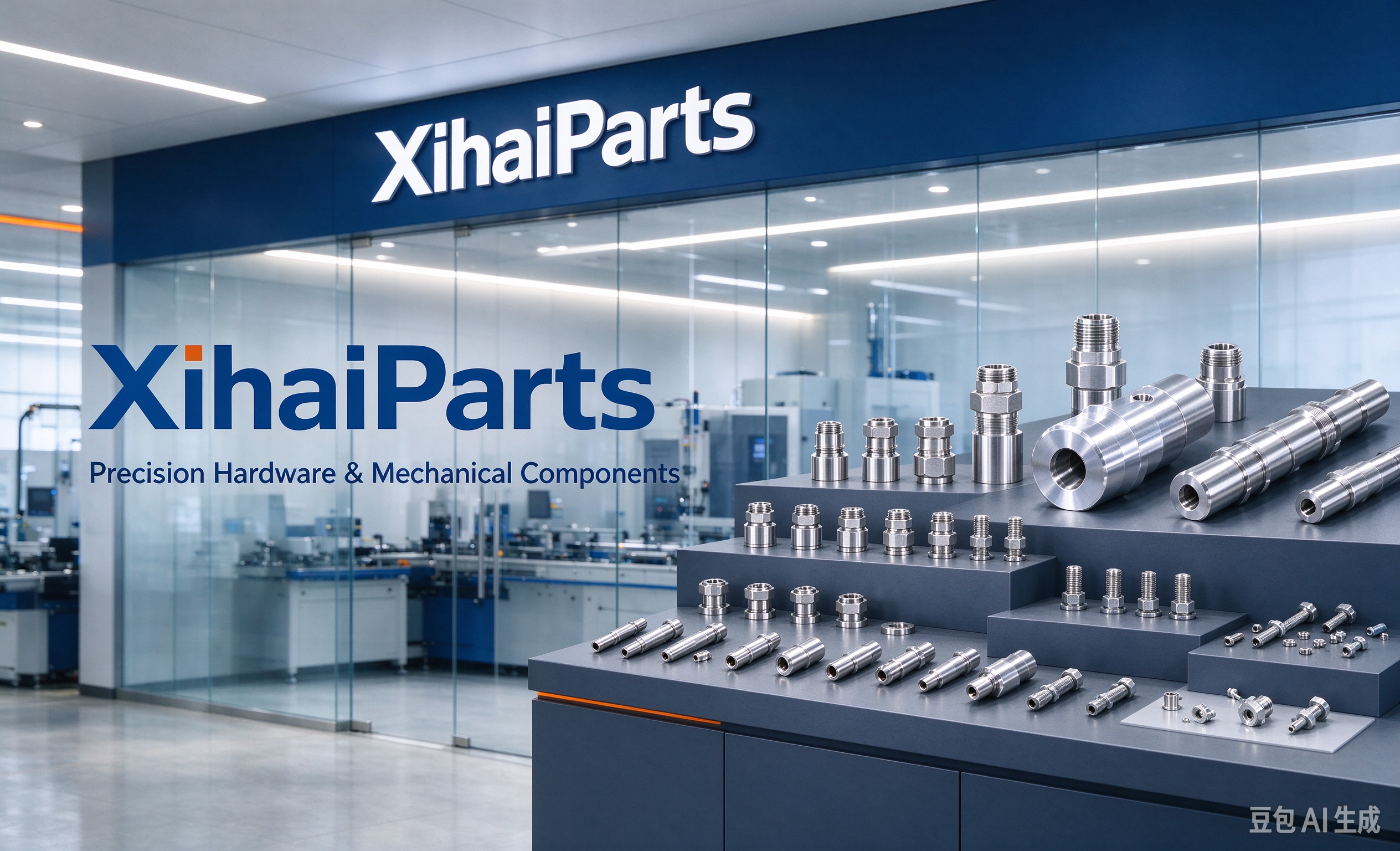
If you open any advanced automated machine, medical instrument or aerospace assembly, you will find one shared foundation: precision mechanical hardware parts. Unlike standard off-the-shelf fasteners and structural pieces, these custom machined hardware components are produced to strict dimensional tolerances, usually measured in micrometers, to guarantee perfect fit, stable movement and long service life in complex systems. Common forms include custom pins, locating shafts, threaded studs, sleeves, mounting brackets, connector blocks and precision bushings, made from metals such as 6061 aluminum, 304/316L stainless steel, brass, 4140 alloy steel and titanium grade 5.
The core difference between ordinary hardware and precision mechanical hardware lies in tolerance control. General stamped or cast hardware may accept deviation of several tenths of a millimeter, while high-grade precision parts often hold ±0.01 mm or tighter. This tiny margin is not over-engineering. When multiple parts stack together in a robot joint or a medical pump, accumulated errors will create backlash, vibration, noise and premature wear. Even a 0.02 mm dimensional drift can make an entire assembly fail to lock, seal or rotate smoothly.
Modern production of precision hardware mainly relies on CNC turning, CNC milling, surface grinding, wire EDM and honing. Multi-axis CNC machines cut solid raw material into target geometry automatically, while grinding and EDM deliver ultra-smooth surface finish for sealing surfaces and sliding contact faces. Surface treatments are also critical: anodizing for aluminum, passivation for stainless steel, black oxide or zinc plating for carbon steel, and hard chrome plating for high-wear surfaces. These treatments add corrosion resistance, reduce friction and extend working lifespan without breaking dimensional accuracy.
Precision hardware serves nearly every high-value industrial sector. Factory automation uses locating pins and fixture hardware for repeatable assembly. Medical device manufacturers select biocompatible stainless steel and titanium hardware for surgical tools and diagnostic machines. New energy equipment, semiconductor test jigs and optical instruments all depend on stable, consistent precision hardware batches.
Many buyers underestimate sourcing risks. Cheap generic hardware may look identical at first glance, yet inconsistent hardness, poor thread pitch or rough surface finish lead to high machine downtime and after-sales complaints. Trusted precision hardware suppliers control the whole workflow: material incoming inspection, first article inspection, in-process dimension sampling, final CMM inspection and batch traceability. For engineering teams, choosing qualified precision mechanical hardware is not just a component purchase; it is an investment in the stability of the whole machine.
In the coming years, as industrial automation and intelligent equipment keep upgrading, demand for tighter tolerance, smaller size and higher reliability precision hardware will keep rising. Good precision hardware stays invisible inside equipment, but it decides whether sophisticated machines can run safely day after day.